It is a truism that you only recognise how brilliant something or someone is as you are about to move on. This is not true for me with Holyhead. It has always been a brilliant town, perched on the edge of Mon overlooking the Celtic Sea. I admit it took me a couple of week when I moved. I seem to remember the wind and rain were of Noahic flood proportions and I could barely see anything during that period.
Caergybi is the UK's second busiest port. It is cosmopolitan by North Wales standards. Its story rich and diverse, and people welcoming. 'Vicar' yelled a car driver narrowly missing running me over 'welcome to Holyhead!' just weeks after I had arrived.
It is Mon's largest town, but in reality is a collection of small villages living together in close proximity. It is a town where small businesses begin and thrive, and people long for the best to happen.
In terms of faith, it is at one and the same time the home of the UK's largest collection of Jedis according to the 2001 Census and a place of deep Celtic Christian heritage. Cybi the saint embedded within Caergbyi gave the town its overarching story and name (Cybi's fort - Caergybi). At one time, pilgrims came from all over the Christian world to see him. Holyhead has by and large forgotten this story... and hopefully the regeneration planned for St Cybi's will help it be told again.
It is a place that has given me a love for Wales, its language, land and people. I will miss it. Yet during this summer, I will enjoy it and remember it fondly as we part.
Pob bendith, Caergybi
Showing posts with label vicar. Show all posts
Showing posts with label vicar. Show all posts
Tuesday, 30 May 2017

Wednesday, 3 May 2017
Half a pace behind: Leading a service in Welsh
I
have noticed that whenever I lead a service in Welsh, the act of worship takes
a little longer. It is not that there are more pauses, but that I say the words
more precisely. I might be tasting the words, perhaps savouring them, although
practically I am slowing down so as not to make as many mistakes. I am half a
pace behind where I would be using English.
One
of the delights of coming to Wales has been the chance to get to grips with
another language. I am not a linguist, although can read various ancient
languages, which is a joy that comes from having been, prior to ordination, a
NT research student and tutor.
There is something inevitably vulnerable about suddenly only having the linguistic capabilities of a young child. Initially, in one language, I might make a stab at talking theology, in the other; I could manage ‘lle dach chi’n byw?’ (Where do you live)? In one memorable moment, I realised I could pronounce iachawdwriaeth (salvation) and not ask for a pint. This has now been addressed.
Leading
worship is though done from a place of weakness, vulnerability and openness.
This is the more true when leading in a second language. I am not referring to
the learning of words and correct pronunciation, which although important are
perhaps not the most important facets for taking worship in a language other
than your mother tongue. Whilst, not the most important; discipline and regular
learning is essential. It is an incarnational thing.
Language
is a gateway to another culture. Until that is appreciated, you cannot begin to
learn another language. Whilst language learning can be simply a case of what
does this mean in that language, which is an important building
block, learning to speak a different language moves you into a different place.
It is impossible to be unaffected by it. This is not a simple reference to the
struggle to get to grips with mutations, or in my case the quiet panic of
having to speak publicly and clearly at key moments of people’s lives.
In the process of learning, everything slows down. This is obvious, perhaps. I need to accept my limitations, for example, I might want to say something, which in English I could do with ease, but in Welsh, simpler ways need to be found in order to accommodate my limitations. Moreover, as time goes by, it is not just my limitations that are exposed, but what I might want to say in my mother tongue cannot be said in Welsh. Direct translation therefore becomes stilted at times. Thus, in the learning, I must make time not just to memorise new words, but begin to hear the spiritual rhythm of the language itself. Perhaps in a sense you do not learn a language without living it.
Sunday, 26 February 2017
I am ail iaith: doing theology one step behind
I
have been doing some thinking - yes, me (probably for something formal). It is
around the notion of ail iaith (Eng: second language). I am proud
of my stuttering attempts to learn Welsh and immerse myself in another culture,
which is distinct from Sheffield, the city which I grew up in and love more the
older I get - the older bit is more poignant this year.
When you are ail iaith - operating in a second language or in a different
culture, you are naturally one step behind. This is obvious in conversations,
when your vocabulary is stretched or you are (still) translating into your
mother tongue and then back again in order to communicate competently, if hesitantly,
in a second language. At the beginning, you are restricted, very restricted, as
you realise that a toddler has more command of the language than you do, and
you find your thoughts that are detailed in one language 'contracted into a
span' in your second. ('contracted to a span' is from Wesley’s hymn Let heaven and earth combine, which is a song about the
incarnation. I wonder in what sense the incarnation is stuttering.... ducking
to hide thunderbolts). In what sense is incarnational theology one pace behind?
Of course being ail iaith might be obvious with language, but for me, I see myself
speaking a different language in other areas too. I am passionate about
theology making sense in urban areas, particularly white working class ones. It
is a moot point whether Holyhead is urban or not, but its estates meet many of
the indexes of deprivation that might be found in Manchester, Liverpool,
Glasgow and Sheffield. Yet I do not speak the first languages of working class areas any more. I did.
But my lived experience is three decades ago, although I have lived on estates
since then as a student, professional and priest, but always in the knowledge
that I could escape if I so wished. Indeed in many ways, learning to speak
articulately and relevantly in such a place is harder than learning the iaith nefoed (language of heaven,
Welsh). For in urban areas, I can slip with effortless ease into thinking that
I do not need to learn, assuming that my three decades old experiences are
normative. When you work in your second language you are not in standard mode.
This
is also the case for me when engaging with black, feminist, womanist or gay
theologies. I am ail iaith. It is an
uncomfortable place, but in the uncomfortability there is vulnerability.
What
would an ail iaith theology look or
feel like? It would be provisional and partial. The practitioner would always
be working as seeing through a glass darkly. Arguably, all practical
theologians do this all the time, and yet there is a danger that we assume that
our way of being is dominant. Certainly a white, heterosexual educated middle class
male can feel that with some degree of ease.
And lest we think that ail iaith are
always deemed to be outside, those we might think are inside are also ail iaith.
In the context of Wales, people born in the country can be second language in
terms of their command of Welsh. English and Welsh speakers can assume that
their identity within the nation is normative.
Finally,
for now one pace behind can be seen as negative, but it might the very thing
that creates the moment in which we can think clearly about what is happening.
The
vulnerability of being like a child again can open doors to new experiences.
More later... perhaps.... gobeithio.
Wednesday, 21 December 2016
Jesse Tree at the Christmas Tree Festival in Holyhead
The Christmas Tree Festival in St Cybi, Holyhead is in full swing.... It is open from 10:30am-3:30pm each day up to and including Christmas Eve.
Each year, I put in a very small Jesse Tree which is dwarfed by the wonderful contribution of other trees and quite rightly so. The Jesse Tree is, in some ways, symbolic of the family tree of Jesus.
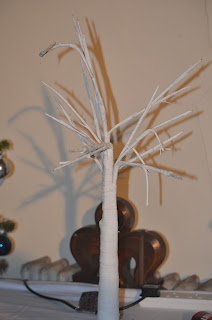
This is why each carving symbolises a story. There is an arc for example and a coat of the technicoloured variety. The tablets of the decalogue are there too.

There are others of course, some well known and some not. A bit like our own family tree
It is well worth a look, and a wonder and wander around one of the most ancient, and perhaps holiest buildings in the port town of Holyhead.
Each year, I put in a very small Jesse Tree which is dwarfed by the wonderful contribution of other trees and quite rightly so. The Jesse Tree is, in some ways, symbolic of the family tree of Jesus.

This is why each carving symbolises a story. There is an arc for example and a coat of the technicoloured variety. The tablets of the decalogue are there too.

There are others of course, some well known and some not. A bit like our own family tree
It is well worth a look, and a wonder and wander around one of the most ancient, and perhaps holiest buildings in the port town of Holyhead.
Sunday, 27 November 2016
Advent Liturgy: I struggled between Law and Grace
I quite like the Decalogue (The Ten Commandments). It is actually neither here nor there whether I like them or not. We recite them in our Churches during Advent and Lent. These are seasons of rich penitence, and so it seems fitting. I wonder though whether we are trying to hem in who is welcome or not. This is not intentional. I accept that absolutely. There are people in our congregations, myself included, who have broken a number, and sometimes their recitation simply serves as a reminder.
Our prayers of intercession then finish with this corporate prayer
Our prayers of intercession then finish with this corporate prayer
Lord Jesus Christ,
you draw and welcome
us,
emptied of pride and
hungry for your grace,
to this your
kingdom’s feast.
Nowhere can we find
the food
for which our souls
cry out,
but here, Lord, at
your table.
Invigorate and
nourish us, good Lord,
that in and through
this bread and wine
your love may meet
us
and your life
complete us
in the power and
glory of your kingdom.
Amen.
How I long for this to be true - and I wonder whether we give people the freedom to be in order to worship and live.
These are just my reflections as a priest worshipping on the First Sunday of Advent
Saturday, 26 November 2016
I love Advent
I love Advent. I like Christmas.
I love the rhythm of a season that embraces both the fast and a rich sense of feast. With its focus perhaps on patriarchs, prophets, the Baptist, Mary of Nazareth and of course Jesus it is a sort of engagement with our family tree. I have a bag by my bed of photos my mum had saved over the years. There are some of me that I would rather no one else saw. But there are others of family and friends that I might have long since forgotten.
Advent affords us the opportunity to celebrate our family, warts and all.
There is also the option of explore Death, Judgement, Heaven and Hell, which usually are given a body swerve in favour of other themes.
They are topics that give us pause for thought... and before Christmas.... that might be a good thing.
That is why I will enjoy deeply wailing and singing longer songs with tunes that are a tad sober. They will help me enjoy December 25th when it comes.
Thursday, 17 November 2016
Lurchers and me
Welcome
Croeso
This blog is about me. I am the Vicar of Holy Island just off of the edge of Anglesey.


Croeso
This blog is about me. I am the Vicar of Holy Island just off of the edge of Anglesey.

I share responsibility with others for a number of brilliant places of worship. from St David's in Morawelon, which is a fairly modern building on an outer council estate to St Cybi's in Holyhead which is set in the town's Roman Fort and worship has taken place there for over a millennium and a half.

Information about the churches can be found here: www.holyheadparishchurches.co.uk
I also own two dogs. Tad Ted and Samwise, They will feature a lot in my blogs.
Look forward to getting to know you.
Subscribe to:
Posts (Atom)